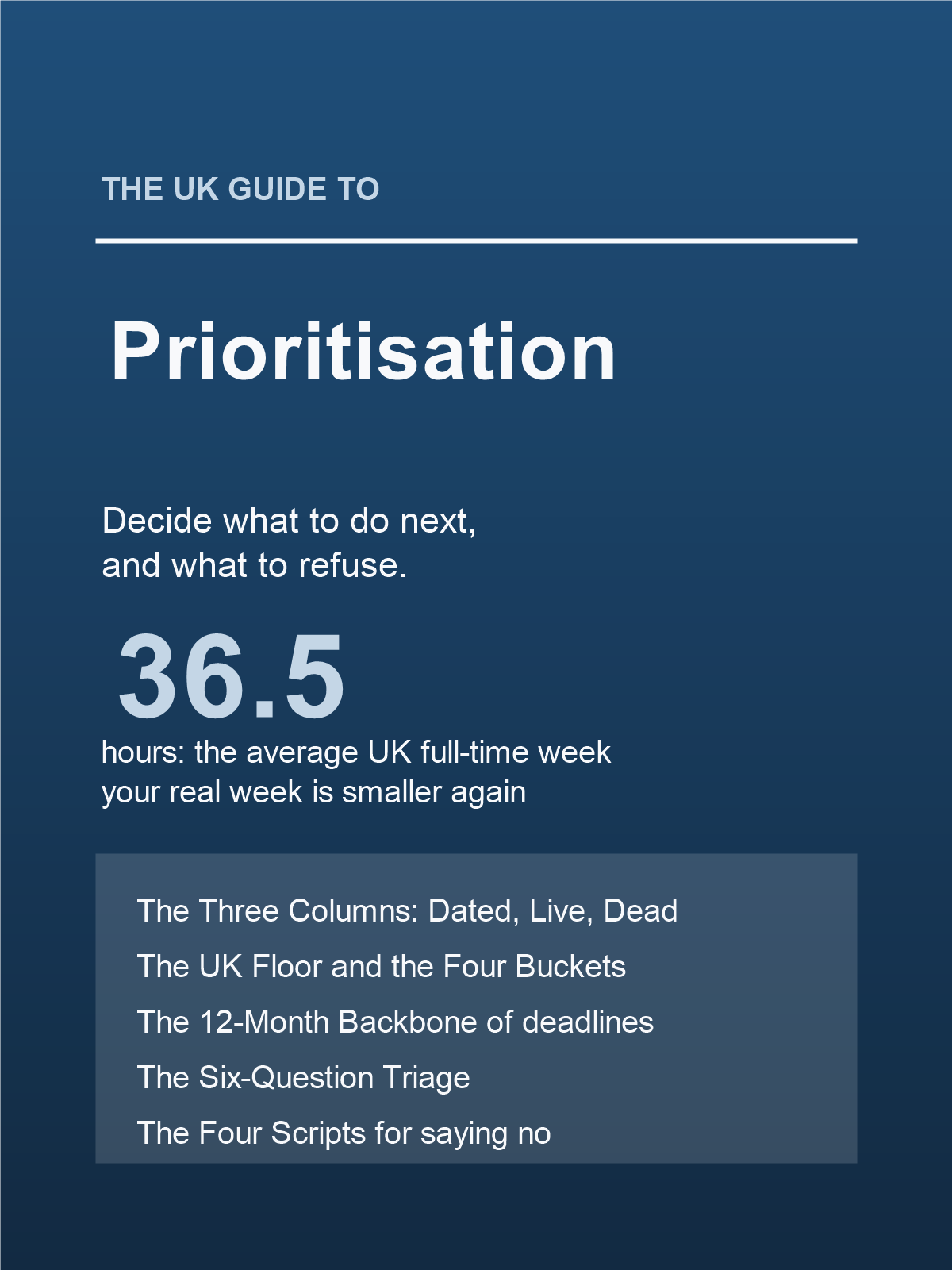
The UK Guide to Prioritisation: Decide What to Do Next, and What to Refuse
Most small businesses do not have a prioritisation problem. They have a subtraction problem — the list is too long and most of it has neither a date nor a consequence. This guide opens with the fact nobody wants to hear: the average UK full-time week is 36.5 hours, not 40, and once the legal rest break, the switches between kinds of work and the admin nobody sees are taken out, a small business owner is choosing between things in roughly 22 to 28 usable hours a week. It then gives you the method that fits inside those hours — and it handles the part of your list that is not a priority at all but a legal deadline with a penalty attached. Nine chapters, eight named frameworks: the Three Columns, the Four Buckets, the UK floor in current rates, the Twelve-Month Backbone, the Real Week, the Six-Question Triage, First-Next-Later and the Four Scripts. You will find out why sorting before ranking matters, what you may not deprioritise — from the Working Time Regulations to Statutory Sick Pay at £123.25 a week since 6 April 2026 — why there is still no statutory right to disconnect, which deadlines you already owe and have never written down, how much time you actually have, how to rank work using facts instead of estimates, and how to say no without burning a bridge. Ends with a day-by-day 30-day plan and a one-page Priority Sheet. Every figure was checked against its original source on the day of publication: ONS, HMRC, Companies House, the Pensions Regulator and legislation.gov.uk. Written for UK business owners, in plain English, by PracticaleBooks.com.
- Price
- £4.99
- Format
- Instant digital download
- Published
Opens the secure checkout in a new tab. Instant access after payment.
What's inside
- The Three Columns: Dated, Live, Dead. Sort everything before ranking anything, because ranking an unsorted list always produces the same answer — the deadlines win and you have not decided anything.
- The Four Buckets: Dated, Contractual, Safety, Chosen. The first three are not decisions, which is the point — it gives you permission to stop treating tax and payroll as competitors for a Tuesday.
- The UK floor in current law and current rates: 48 hours averaged over 17 weeks, 11 hours' daily rest, a 20-minute break after six hours, 5.6 weeks' statutory leave, and what you may not deprioritise.
- Statutory Sick Pay as it now stands: £123.25 a week or 80% of average weekly earnings, whichever is lower, from the first full day, for up to 28 weeks — no waiting period and no earnings floor since 6 April 2026.
- Why there is still no statutory right to disconnect in Britain, so the boundary between work and not-work is a policy you write rather than a rule you can cite — plus the six lines that write it.
- The Twelve-Month Backbone: Self Assessment on 31 October, 31 January and 30 December, Corporation Tax nine months and one day after the period end, and the confirmation-statement fee clock that catches people out.
- The £90,000 VAT threshold with its 30-day registration window, and Making Tax Digital for Income Tax from April 2026 with its four quarterly update dates and the phased thresholds.
- Capacity before priority: measure three weeks, count your switches, subtract the unseen admin, subtract leave, then subtract a fifteen per cent buffer that is never scheduled. Most owners find a third less time than they assumed.
- The Six-Question Triage: six questions scored 0 to 2 that ask about facts rather than estimates — and why ICE, RICE and WSJF multiply two guesses and hand you confidence instead of accuracy.
- First, Next, Later, and the rule that makes it work: nothing displaces the First without being closed and written down. Why two Firsts is the most common failure, and how the parking lot prevents it.
- The Four Scripts for saying no — Defer with a date, Decline in three sentences, Redirect, Trade — the politeness tax priced honestly, and why a trade must always name what it stops.
- The Delegation Ladder: five rungs, the written definition of done most owners skip, four triage categories borrowed from the NHS because nobody argues about the number, only the facts. Plus the 30-day plan and the Priority Sheet.
How you get it
- Pay securely through Payhip, the store that processes every order.
- The download link is emailed to you the moment payment clears.
- A PDF, readable on any phone, tablet or computer.