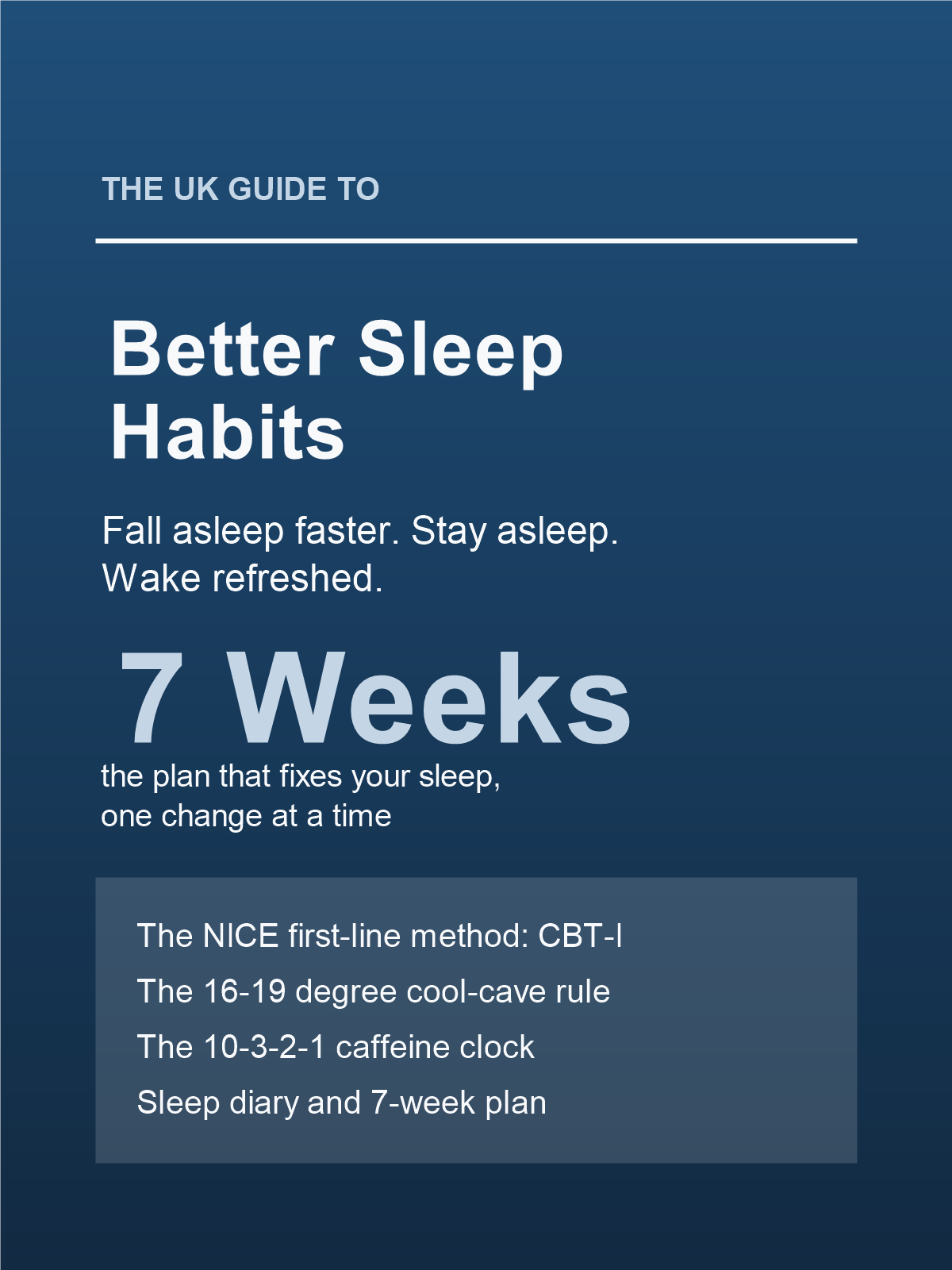
The UK Guide to Better Sleep Habits: Fall Asleep Faster, Stay Asleep, and Wake Refreshed
This seven-week method is built on the treatment the NHS recommends first for insomnia. Most sleep advice is a list of rules you cannot remember; this guide is a sequence — measure first, then one change a week — that ends with you holding your own numbers and your own routine. It names the two forces that actually control sleep (sleep pressure and the body clock), shows you why 'tired' and 'sleepy' are different signals, and gives you the ten levers that matter: the fixed wake-up anchor, the 20-minute rule for restless nights, the 10-3-2-1 caffeine and alcohol clock, the 16 to 19°C cool-cave room, the worry box that parks 3am thoughts, and the daytime handoff of light, food and movement. Every claim is traceable to a real source — the caffeine-at-six-hours study, the CBT-I meta-analyses, the NHS and NICE guidance — and nothing in it asks you to buy or take anything. You get a printable sleep diary, a one-page audit, a 7-week plan, a 20-term glossary, and the exact signs that say it is time to see your GP (sleep apnoea, restless legs, persistent insomnia, low mood). Written for UK readers, in plain English, by PracticaleBooks.com.
- Price
- £4.99
- Format
- Instant digital download
- Published
Opens the secure checkout in a new tab. Instant access after payment.
What's inside
- The two engines that control sleep — sleep pressure and the body clock — and why 'tired' and 'sleepy' are different signals. Nearly every tip you've heard runs one without the other.
- The sleep diary audit: five numbers over seven mornings — latency, wakings, wake time, total sleep, efficiency — that turn 'I sleep badly' into a fixable baseline. Paper beats trackers for the numbers you act on.
- The fixed anchor: one wake time, seven days a week, is the strongest single lever — with daylight in the first hour and the NHS rule that you never sleep in after a bad night.
- The 20-minute rule, the core of NICE's first-line CBT-I: awake twenty minutes, get up; cap time in bed at your average sleep plus 30 minutes. The trials show roughly a 50% cut in insomnia symptoms.
- The research behind the 10-3-2-1 clock: caffeine six hours before bed still cost healthy sleepers over an hour of sleep, unnoticed — and alcohol buys falling asleep and charges interest at 3am.
- The cool cave: your core must drop about half a degree to sleep, so the room runs at 16-19°C, skin warms one to two hours before bed, dark beats light, and the clock leaves the bedroom.
- The wind-down and the worry box: screens off an hour before lights out, a routine that is boring by design, and ten minutes on paper that park the 3am thought-loop until tomorrow.
- The daytime handoff: exercise more than four hours before bed, the big meal three hours out, naps capped at 20 minutes and finished by 3pm, daylight by day and dimness in the evening.
- The 3am protocol — what early waking actually means (alcohol rebound, late caffeine, a 21°C room) and the five-step response that turns a 90-minute wake into ten minutes of rest.
- The 7-week plan: baseline week, then one lever a week — clock, 20-minute rule, cool cave, day handoff, review, maintain — scored by your own diary and ending in two habits you keep for life.
- Special situations done honestly: new parents, shift workers, perimenopause and early risers — plus the signs that say see your GP: apnoea, restless legs, persistent insomnia, low mood.
- Printable sleep diary, one-page audit and 7-week table, a 20-term glossary, and eight verified sources — NHS, NICE-recommended Sleepio, and the caffeine-at-six-hours study.
How you get it
- Pay securely through Payhip, the store that processes every order.
- The download link is emailed to you the moment payment clears.
- A PDF, readable on any phone, tablet or computer.