- lunch break workout
- 30 minute workout
- short workout
- strength training
- micro-workouts
- exercise snacks
- post meal exercise
- resistance training
- home fitness
- no equipment
- busy professionals
- workplace fitness
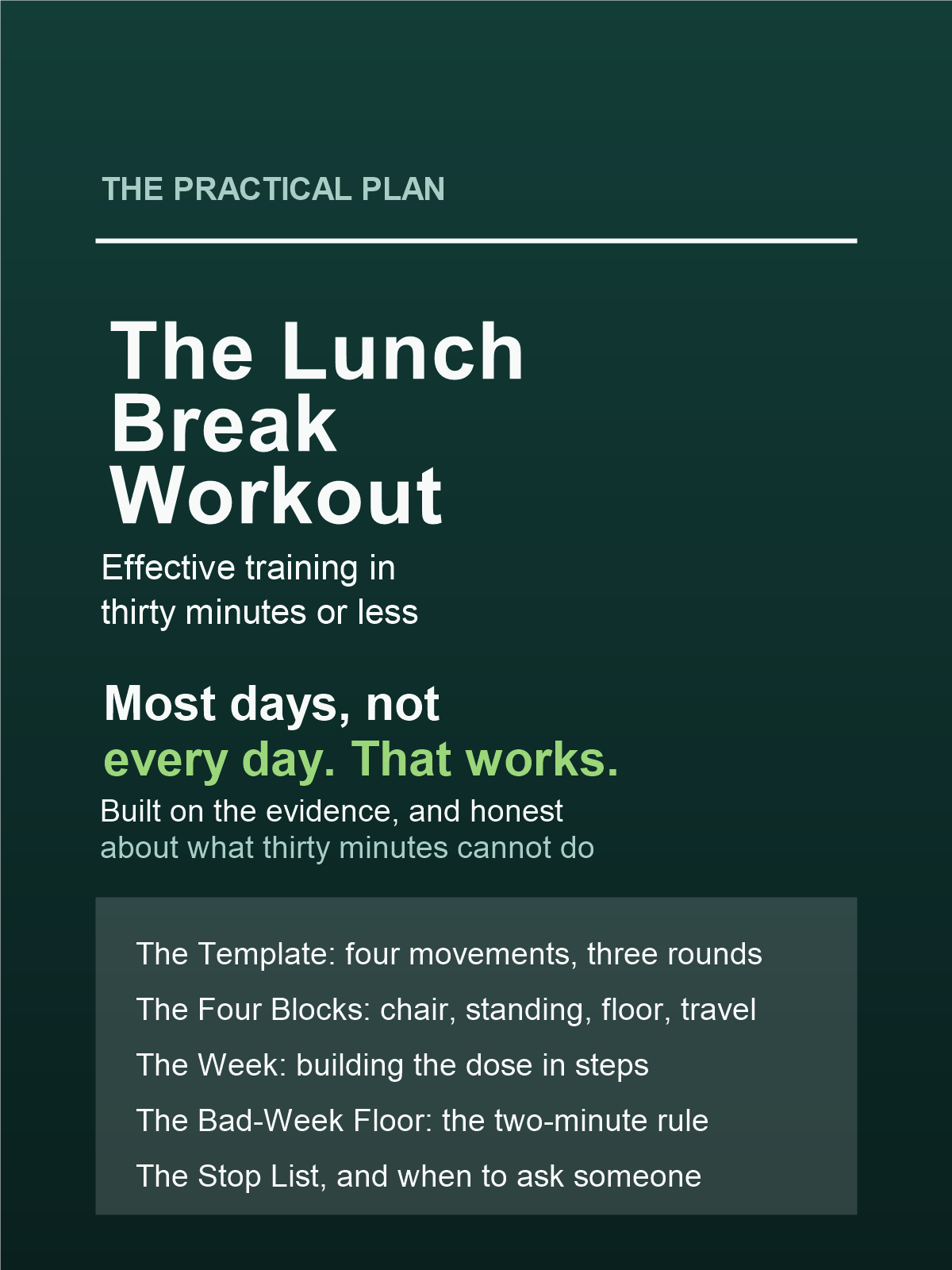
The Lunch Break Workout: Effective Training in 30 Minutes or Less
This guide argues against its own title, and that is the point. A 30-minute lunch session is real — it improves strength, interrupts sitting and changes how the rest of the day feels — but the post-meal blood-sugar claim is weaker at lunch than at breakfast, the minimum effective dose is smaller than 30 minutes, and a session does not replace a sedentary rest of the day. The evidence is sound: 2026 dose-response meta-regression (67 studies, 2,058 participants) shows diminishing returns; 2026 split-volume trial (45 men, 8 weeks) shows no detectable strength loss from splitting; 2026 umbrella review (21 RCTs, 921 participants) shows VO2max improves; 2026 circuit-rest study shows shorter rest = higher cardiovascular load, longer rest = more metabolic stress; 2026 meta-analysis shows postprandial exercise is strongest after breakfast and non-significant at dinner. The Template, Four Blocks, 12-week Week ladder, Lunch Timing chapter, and 2-minute Bad-Week Floor are included. Every claim carries its limitation printed beside it.
- Price
- £4.99
- Format
- Instant digital download
- Published
Opens the secure checkout in a new tab. Instant access after payment.
What's inside
- Opens with its own claim: the postprandial blood-sugar promise is weakest at lunch (2026 meta-analysis: breakfast strongest, lunch weaker, dinner null).
- The 30-minute session is real — but 30 minutes is more than the minimum effective strength dose, not a substitute for a weekly programme.
- Dose-response meta-regression 2026 (Sports Med; 67 studies, 2,058 participants): strength gains increase with volume and frequency, with diminishing returns — the first hard sets yield more per minute than the fifth.
- Split-volume trial 2026 (J Exerc Sci Fit; 45 men, 8 weeks): same squat volume split across 3 daily bouts produced no detectable strength difference vs one session — and enjoyment was significantly higher (p = 0.034).
- Postprandial timing gradient: exercise >60 min after a meal gives largest glucose reduction; lunch effect attenuates to non-significant (g = −0.19) vs breakfast (g = −0.41); dinner is essentially null (g = 0.03).
- Exercise-snack evidence (Front Nutr 2025; 17 RCTs, 261 participants): glucose iAUC reduced (SMD −0.49) but I² = 76% unstable; real-world trial (Diabetologia 2026; n = 31) improved variability, not mean glucose (p = 0.07).
- Interrupting sitting requires resistance, not just walking (J Clin Lipidol 2025; 4-min hourly walking breaks lowered non-HDL cholesterol). 2026 trial shows walking + resistance hourly reduced 26-hour glucose by 17.3%; walking alone did not.
- The Template: 4 movements (push, pull, legs, core/carry), 3 rounds, 2-min per movement, 30-sec rest, 3 rounds = 22 min work + warm-up/cool-down = 30 min total.
- The Four Blocks: Chair-Block (no floor, no equipment), Standing-Block (interrupted sitting), Floor-Block (full session), Travel-Block (4-min flat, from the real-world trial).
- The Week ladder: 2 sessions/week starts; add intensity before frequency; the 30:30 circuit (Sci Rep 2025) for intensity variation in weeks 9–12.
- The Lunch Timing chapter: before, with, or after the meal — with the evidence for each. Not a marketing claim; a timing choice.
- Every claim carries its limitation printed beside it: 79% male studies, 31-participant trials, subgroup findings that need individual-participant data, and confidence intervals that cover both benefit and harm.
How you get it
- Pay securely through Payhip, the store that processes every order.
- The download link is emailed to you the moment payment clears.
- A PDF, readable on any phone, tablet or computer.