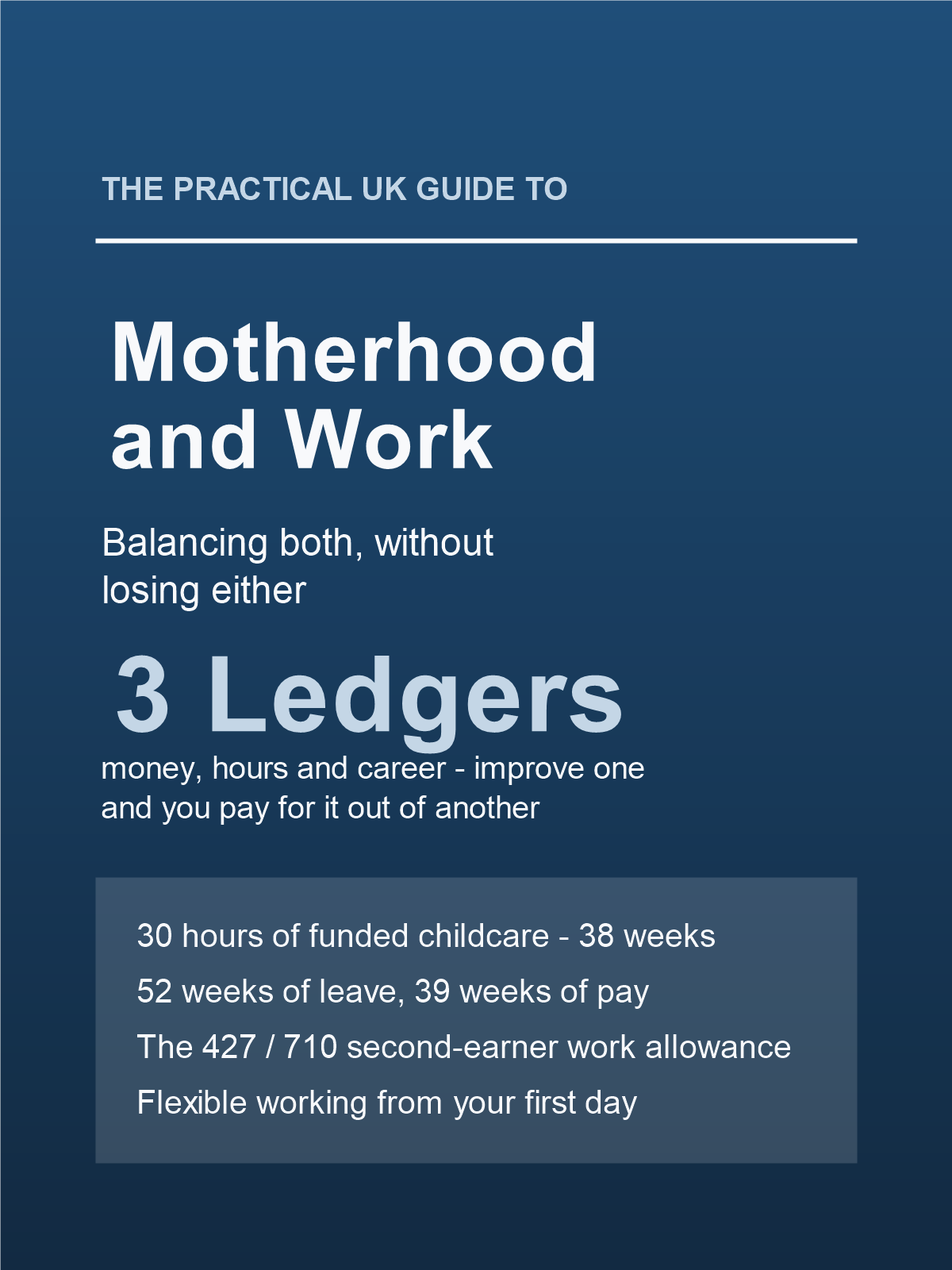
Motherhood and Work: Balancing Both, Without Losing Either
The UK's largest childcare subsidy is conditional on both parents working, runs for 38 weeks a year rather than 52, and disappears the moment one parent stops. Most mothers discover this after the decision is made. This guide is built so you discover it first, and end with a written working arrangement instead of a compromise you did not choose. It names the three ledgers you are actually balancing — money, hours and career — and shows that improving one is always paid for out of another. Then it works through the system in order: the funded childcare hours and the conditions attached to them, the entitlement audit that converts national policy into your family's own weekly numbers, the leave map for 52 weeks of leave against 39 weeks of pay, the four-line flexible working request, the 1,140-hour childcare gap, the second-earner work allowance, the part-time pay trap, and the household plan that survives a bad week. It ends with a 30-day plan and two one-page documents that are yours to enforce. Every figure was verified against GOV.UK, the Office for National Statistics, the Institute for Fiscal Studies and Coram Family and Childcare on the day of writing, with the year each one applies to stated openly. Nothing in it asks you to buy or take anything. Written for UK readers, in plain English, by PracticaleBooks.com.
- Price
- £4.99
- Format
- Instant digital download
- Published
Opens the secure checkout in a new tab. Instant access after payment.
What's inside
- The Three Ledgers — money, hours and career. Why 'it doesn't balance' is a diagnosis rather than a mood, and why cutting hours is one of the most expensive ways to buy time in the UK.
- What the system actually pays: 30 hours of funded childcare from nine months old in England, the 85% Universal Credit childcare element capped at £1,071.09 a month, and Tax-Free Childcare's £2,000.
- The two conditions that gate almost all of it — both parents in work, and 38 funded weeks rather than 52 — and what happens to your hours and your entitlements when one parent stops working.
- The Entitlement Audit: one evening that turns national policy into your own weekly numbers, including the figure almost nobody calculates, your childcare cost per hour of your own working life.
- The Leave Map: 52 weeks of maternity leave against 39 weeks of pay, the £129 weekly earnings threshold that can void the whole entitlement, and how to assign the 13 unpaid weeks.
- The Hours That Fit: flexible working from your first day in the job, the two-month decision deadline, the eight lawful reasons an employer may refuse, and a four-line request with a trial period.
- The 1,140-Hour Gap: the childcare your job actually needs against the 1,140 hours the state funds, the roughly £2,000 a year nobody covers, and why stretching hours gives you about 22.
- The Second-Earner Taper: one work allowance per household at £427 or £710 a month, the 55p-in-the-pound taper, the childcare cap — and why your partner's hour is often worth more than yours.
- The Career Account: half-time hours stop your wage progressing altogether. The IFS findings on the motherhood penalty, and the four deposits that protect your standing while you work fewer hours.
- The Household Grid: named owners for nights, mornings, admin, weekends and the fallback — with the evidence that unpaid care gaps come from defaults, not from families choosing them.
- The 30-Day Plan: find out, audit, grid, write — ending in two one-page documents, a Working Arrangement and a Household Plan, read aloud to the other adult.
- Every figure verified on the day of writing against GOV.UK, the ONS, the Institute for Fiscal Studies and Coram Family and Childcare's 2026 survey, with the year each one applies to stated openly.
How you get it
- Pay securely through Payhip, the store that processes every order.
- The download link is emailed to you the moment payment clears.
- A PDF, readable on any phone, tablet or computer.