- mobility
- desk workers
- sedentary behaviour
- posture
- back pain
- stretches
- office health
- sit-stand desk
- strength training
- workplace health
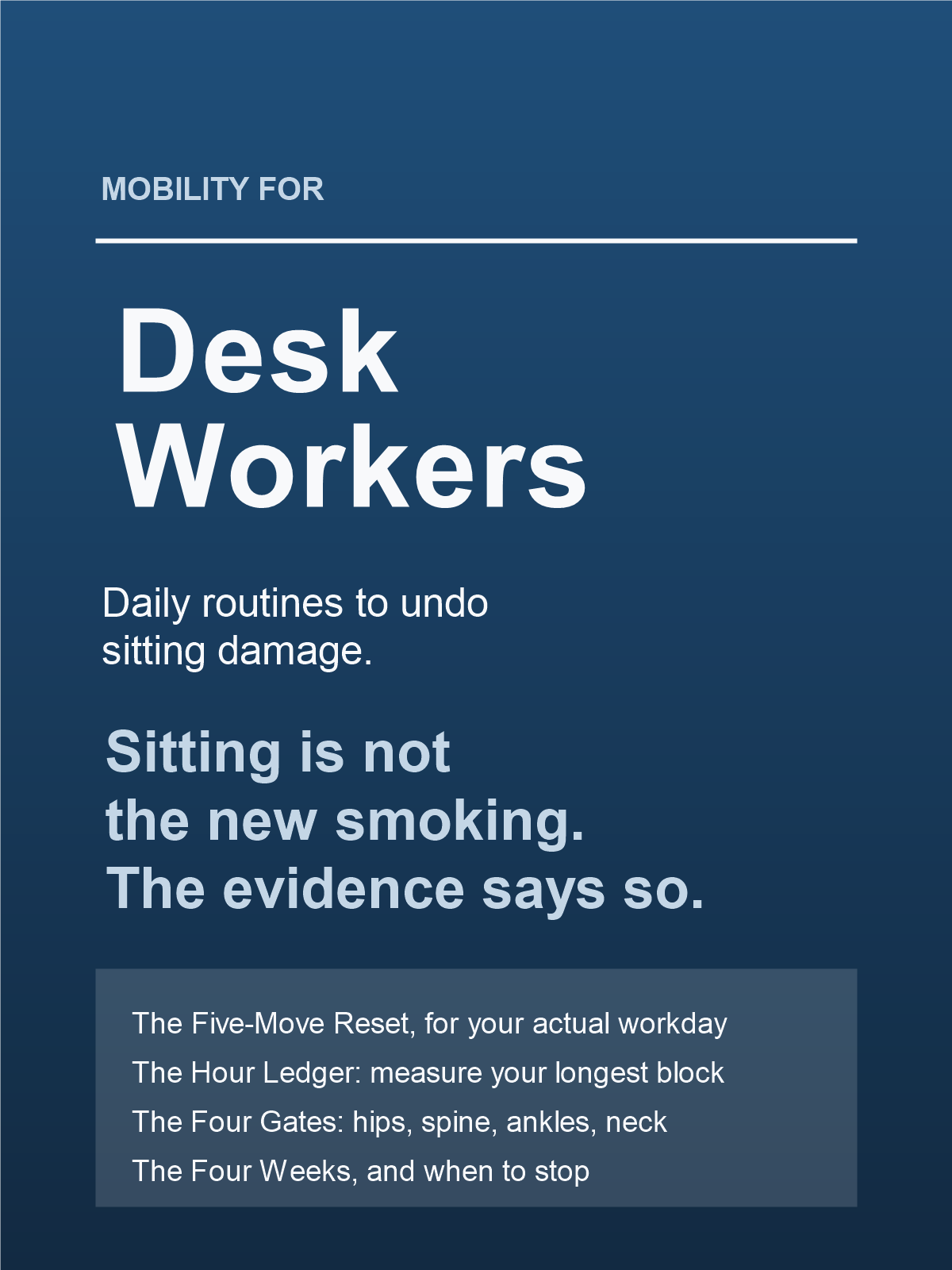
Mobility for Desk Workers: Daily Routines to Undo Sitting Damage
<p>The first two chapters of this book argue against its own title. That is the point.</p><p>Most guides about sitting repeat four claims. This one tests them, and three do not survive. Sitting is not the new smoking: 190 excess deaths per 100,000 people a year against more than 2,000 from heavy smoking. Standing is not better than sitting: a meta-analysis of objectively measured desk work found no significantly less back pain from standing (p = 0.36). And cutting sitting time did not change health: 38 minutes a day across 3,169 people, with no physical or psychological outcome improving. Even the desk fails - sit-stand desks sat 85% of the workday across two months of monitoring.</p><p>So the book is built on what does hold. The dose is two to three minutes of lower-limb movement every twenty to thirty minutes. Resistance has to be in the break, not just walking. And a ratio decided in advance beats one chosen in the moment: a fixed 30:15 schedule beat a self-selected one on pain, stress, concentration and adherence.</p><p>Inside: the Five-Move Reset, a four-minute desk break; the Hour Ledger, a twenty-minute audit of your longest unbroken block; the Four Gates, an evening protocol for hips, spine, ankles and neck; a fixed-ratio plan; a four-week installation schedule; and the red flags that mean you should stop stretching and speak to someone. Every claim carries its own limitation, printed next to it.</p><p>41 pages. Not medical advice, and not a treatment.</p>
- Price
- £4.99
- Format
- Instant digital download
- Published
Opens the secure checkout in a new tab. Instant access after payment.
What's inside
- Opens by dismantling its own premise: sitting is not the new smoking. 190 excess deaths per 100,000 a year, against more than 2,000 from heavy smoking.
- Standing is not better than sitting. A meta-analysis of objectively measured desk work found no significantly less back pain from standing (p = 0.36, I2 = 90%).
- Cutting sitting by 38 minutes a day across 3,169 people changed no physical or psychological outcome measured. Only one cholesterol subfraction moved.
- The dose the evidence actually supports: 2-3 minutes of lower-limb movement every 20-30 minutes. From a 2026 systematic review of 24 studies.
- Resistance in the break is what makes it work. Alternating an 8-minute walk with 8-minute resistance every hour cut 26-hour glucose exposure by 17.3%.
- A decided ratio beats a chosen one. A fixed 30:15 sit-stand schedule beat a self-selected one on pain, stress, concentration and adherence.
- The Five-Move Reset: a four-minute, no-equipment break you can do at your desk. Ankle pumps, sit-to-stands, marching, chest opener, chin tucks.
- The Hour Ledger: a 20-minute audit that measures your longest unbroken sitting block rather than your total, because that is the number that matters.
- The Four Gates: hips, spine, ankles and neck, in the order sitting restricts them. Five minutes, evenings. Three 30-second holds and one rotation.
- Stiffness is measurable at thirty minutes of stillness and noticeable by sixty - the most reliable thing sitting does to you, and reversible in seconds.
- Every claim carries its own limit: the 56-person trial, the 140-person trial where pain fell equally in all four arms, and the energy-expenditure caveat.
- 41 pages. British English, no filler, and every figure checked against its original source on 9 October 2026.
How you get it
- Pay securely through Payhip, the store that processes every order.
- The download link is emailed to you the moment payment clears.
- A PDF, readable on any phone, tablet or computer.