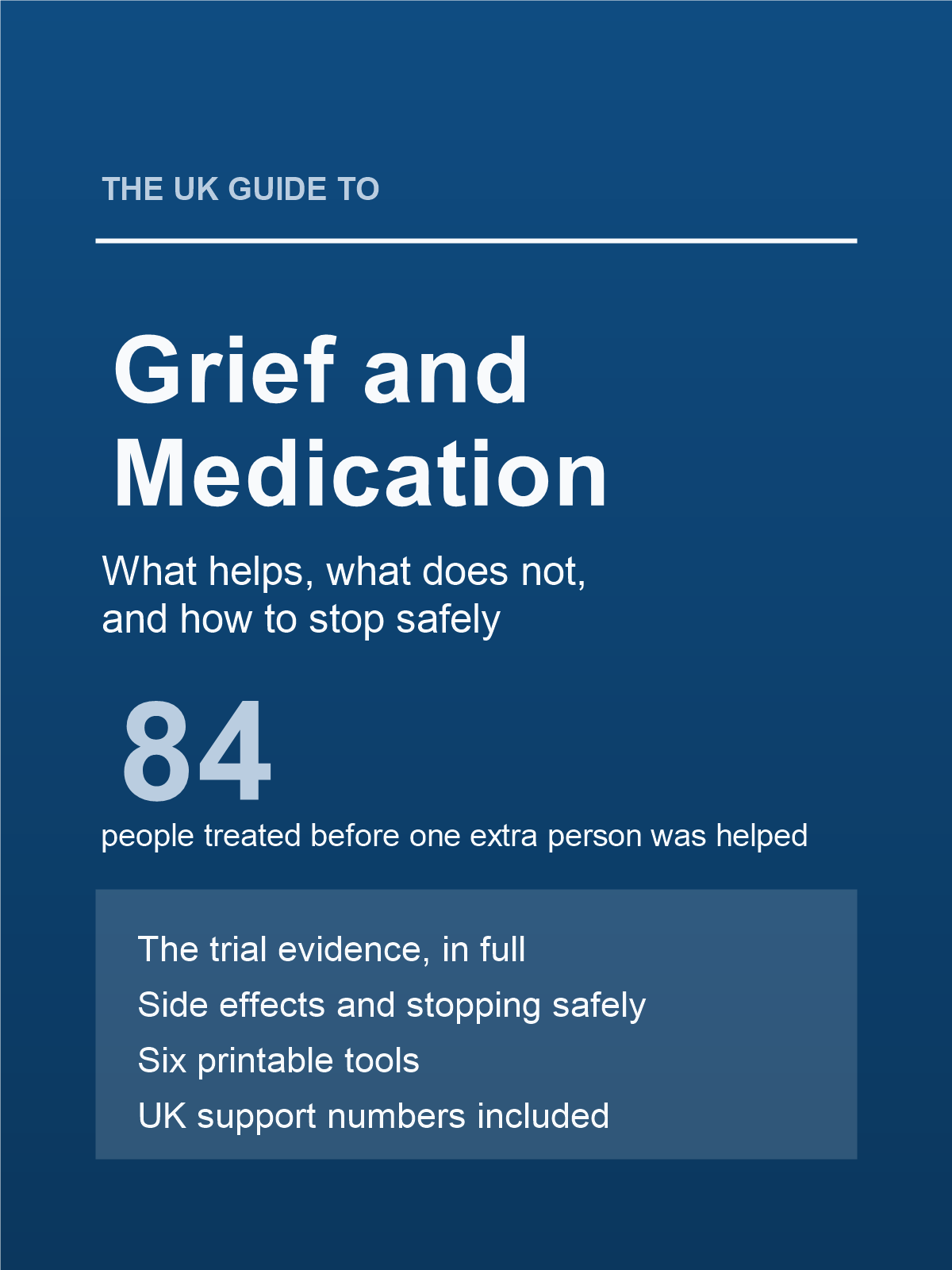
Grief and Medication: When Medication Helps
Antidepressants have never been shown to work on grief itself - not once, in any properly controlled trial. The best study ever run, 395 bereaved people with a real placebo and a real clinician-rated outcome, found that adding an antidepressant to grief therapy improved the depression that came with the loss and did nothing measurable for the grief: a number needed to treat of 84. What worked in that same trial was 16 sessions of grief-focused therapy, which more than doubled the response rate. Meanwhile the placebo group improved at 54.8% - more than half of what gets credited to the tablet was going to happen anyway. This guide holds all of that at once, without either demonising medication or pretending it does something it has not been shown to do. It covers the trial in full, the side effects nobody volunteers, how to taper off safely, what NICE actually tells your GP to do first, and the questions that turn a prescription into a conversation.
- Price
- £4.99
- Format
- Instant digital download
- Published
Opens the secure checkout in a new tab. Instant access after payment.
What's inside
- The finding nobody markets: no antidepressant has ever beaten a placebo for grief itself. In the best trial ever run - 395 bereaved people, real placebo - the number needed to treat was 84. One extra person helped, out of 84.
- That trial in full: citalopram against placebo, with and without grief-focused therapy. Therapy beat placebo 82.5% to 54.8%. The pill added nothing to grief - and did significantly help the depression.
- Why the benefit only runs one way. Adding the pill to the therapy did nothing for grief. Adding the therapy to the pill lifted responses from 69.3% to 83.7%. Therapy cut suicidal ideation five-fold; the drug did not.
- Thirty years of studies nobody quotes: in one, depression fell 54% while grief moved 5%. In another, 83% responded on depression and 45% on grief. Nearly all were open-label with no placebo, so they could not separate drug from time.
- Medication's most valuable job may be making therapy possible. People on a stable antidepressant were 2.7x more likely to respond to grief therapy and six times more likely to finish it - because depression had been stopping them grieving.
- Benzodiazepines: the one trial where the drug made it worse. Diazepam against placebo after bereavement - no difference in grief at all, and MORE sleep problems in the diazepam group at seven months. Plus a real dependence risk.
- Stopping badly is its own catastrophe: 56% relapsed within a year of coming off long-term antidepressants, against 39% who stayed on. And 56% of people experience withdrawal. How to tell withdrawal from relapse.
- You may be able to stop. 30-50% of long-term users have no evidence-based indication to continue. NICE's taper: 50% then 25% steps, one to two weeks at each, led by you - and weeks or months, not weeks.
- The UK pathway most people are never told: for less severe depression NICE says do not routinely offer a first-line antidepressant - only on your informed preference. Guided self-help comes first. Know the word to listen for.
- Side effects honestly: sexual function (far more common than the 5% in trials, and now a persistent-dysfunction warning in several countries), emotional blunting, hyponatraemia and falls, and the one-week suicide-risk review for under-25s.
- Grief-focused therapy is what has the evidence: 82.5% response, 71% in older adults, pooled online-CBT effect around d=0.79. Section 6 gives you the behavioural-activation version you can start today, without a waiting list.
- Six printable tools: medication summary, withdrawal diary, GP appointment script, appointment checklist, how to support someone, and warning signs - plus free UK helpline numbers for Samaritans, Cruse, SANDS and SOBS.
How you get it
- Pay securely through Payhip, the store that processes every order.
- The download link is emailed to you the moment payment clears.
- A PDF, readable on any phone, tablet or computer.