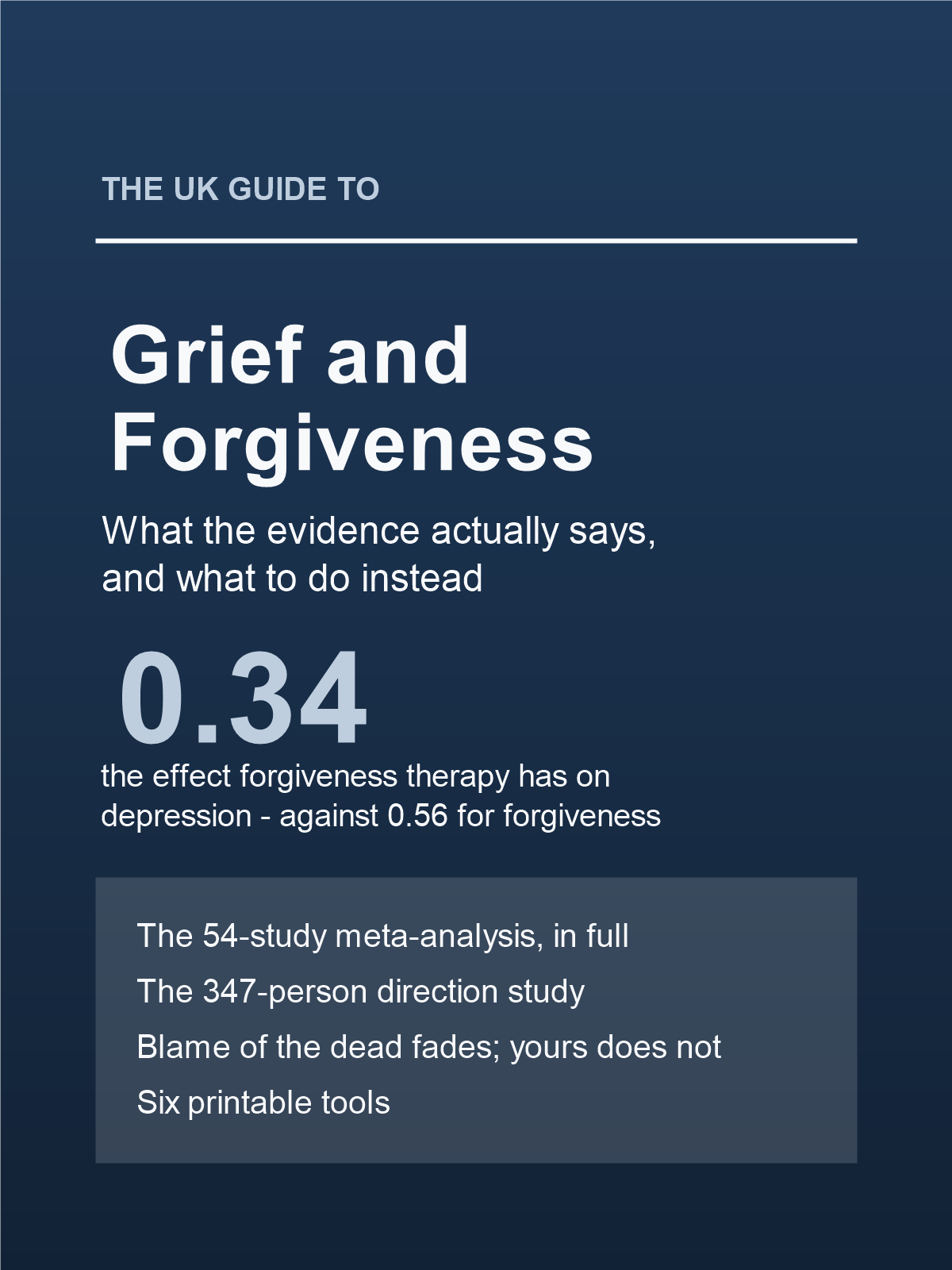
Grief and Forgiveness: Forgiveness in Grief
Nobody has shown that forgiving makes grief better. In the one longitudinal study designed to settle the direction of causation - 347 people, four waves over six weeks - the arrow pointed the other way: as people felt better, they became more forgiving, but forgiveness did not predict later improvement. The evidence that does exist is narrower than the marketing. A 2014 meta-analysis of 54 studies and 2,323 people found explicit forgiveness treatment produced more forgiveness than no treatment (effect 0.56) - and an effect on depression of only 0.34, roughly 40-50% smaller than the effect on forgiveness itself. Forgiveness therapy raises forgiveness more reliably than it lowers distress. And none of it is about bereavement: the founding trials explicitly excluded people who were grieving, so no forgiveness therapy trial has ever been run on bereaved people. What the grief research found instead is sharper and far more useful - blame of the dead stops predicting distress after fourteen months, while self-blame predicts it across the full sixty, and the real mechanism behind any benefit of forgiveness is less rumination, which you can act on this week without forgiving anyone.
- Price
- £4.99
- Format
- Instant digital download
- Published
Opens the secure checkout in a new tab. Instant access after payment.
What's inside
- Nobody has shown that forgiving makes grief better. In the one study designed to settle the direction of causation - 347 people, four waves, six weeks - the arrow pointed the other way: feeling better predicted forgiveness, not the reverse.
- The definitive meta-analysis in full: 54 studies, 2,323 people. Forgiveness 0.56, anxiety 0.63, hope 1.00, and depression 0.34 - the weakest emotional outcome, 40-50% below the effect on forgiveness itself.
- It was the hours, not the model. Once you control for dosage and individual-vs-group format, the treatment model stops predicting anything. The famous twenty-step method's advantage was a confound with length.
- 'Just decide to forgive' does literally nothing: effect -0.04 in the meta-analysis that tested it, from interventions averaging four hours. But a decision is a stage in a process, not a treatment.
- No forgiveness therapy trial has ever been run on bereaved people. The founding studies excluded anyone 'going through a grieving process'. Every forgiveness exercise for grief is extrapolated from abuse survivors.
- The finding worth the price: blame of the dead stops predicting distress at fourteen months; self-blame predicts grief symptoms across the full sixty. Your effort belongs on one of your two blames - not the one most people spend it on.
- Self-blame is a risk factor unless it leads to amends. In 244 bereaved people, self-blame predicted poor adjustment - but when it produced amends or reparations, the association reversed entirely.
- Revenge after homicide: unrelated to time since the loss, unrelated to the sentence, and significantly lower when the perpetrator was family. Rage tracks closeness, not desert.
- Anger is a symptom of disturbed grief, not its cause. Across nearly seven years of follow-up in MH17-bereaved, prolonged grief predicted later anger - anger did not predict grief.
- The actual mechanism is less rumination, which mediated 36% of the forgiveness-depression link in US and Korean samples. Not love, not peace - a cognitive habit you can work on.
- Self-forgiveness after suicide loss: high levels pulled every group to the same floor of depression and suicidal thinking regardless of how they died. Low levels marked the highest-risk group. Correlation, and the guide says so.
- Six printable tools: blame ledger, rumination log, amends letter, forgiveness decision sheet, questions to ask a therapist, and warning signs - plus UK helplines verified on 3 October 2026.
How you get it
- Pay securely through Payhip, the store that processes every order.
- The download link is emailed to you the moment payment clears.
- A PDF, readable on any phone, tablet or computer.